
Capacitor Recycling Line
Latest News
Got any Questions?
CALL US NOW
Mobile: 0086 186 5335 4363
Tel / Fax: 0086 533 3588750
Email: info@crusher-world.com

Capacitor Recycling Line
Capacitors are composed of electrodes (such as metal foil), dielectrics (such as ceramic/film), and casings (such as metal/plastic). Capacitors are made of a mixture of materials, resulting in high metal loss and difficulty in separation, greatly increasing the difficulty of breaking them.
The capacitor recycling line designed by UTMACH is a professional equipment developed for this type of high-value-added electronic waste. It can recycle copper, aluminum, iron, nickel and rare and precious metal materials, realizing the recycling of resources.
Workflow
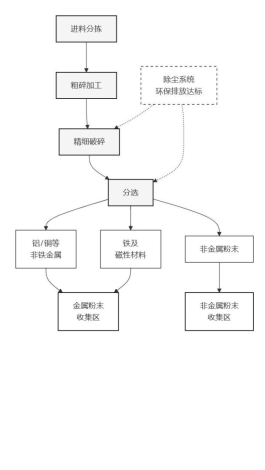
Feed Sorting: Scrap capacitors, electrolytic capacitors, and aluminum-cased capacitors are fed into the system via a conveyor.
Coarse Shredding: A shredder performs preliminary crushing of the capacitors, cutting them into granular materials suitable for subsequent processing.
Fine Shredding: A crusher further pulverizes the capacitors, completely separating the metal from the electrolytic paper and plastic casings.
Sorting: A magnetic separator and eddy current separator separate the iron casing and magnetic material from the capacitors.
Dust Removal System: Dust removal equipment is equipped to remove residual electrolyte gas and dust, ensuring environmentally friendly emissions.
Material Collection: Reusable metals such as aluminum powder, copper powder, and iron powder are obtained, as well as non-metallic powders that can be reused as auxiliary materials.
Main Equipment
Conveyor
Shredder
Fine Crusher
Magnetic Separator
Eddy Current Separator
Dust Removal System
Electronic Control System
Equipment Advantages
Complete Separation: Utilizing a multi-stage sorting system, the metal recovery rate reaches 98%.
High Compatibility: Capable of processing a wide range of capacitors (electrolytic, film, aluminum-cased, solid-state, etc.).
High Economic Efficiency: Metal powder can be directly recycled back into the furnace, resulting in a short payback period.
Modular Design: The entire line can be flexibly configured based on production volume, making it easy to maintain and expand.
Safe and Environmentally
Safety and environmental protection:No high-temperature smelting is required, preventing secondary pollution.
Applications:
Used electrolytic capacitors and solid-state capacitors;
Electronic waste recycling and processing;
Electronics factory scrap;
Mixed waste such as capacitor casings and guide pins
Resources, Environmental Protection, and Industrial Value
Capacitor recycling can recycle metals and other resources, reduce hazardous pollution, and provide a regulatory compliance path for related industries, contributing to green development.
The capacitor recycling line designed by UTMACH is a professional equipment developed for this type of high-value-added electronic waste. It can recycle copper, aluminum, iron, nickel and rare and precious metal materials, realizing the recycling of resources.
Workflow
Feed Sorting: Scrap capacitors, electrolytic capacitors, and aluminum-cased capacitors are fed into the system via a conveyor.
Coarse Shredding: A shredder performs preliminary crushing of the capacitors, cutting them into granular materials suitable for subsequent processing.
Fine Shredding: A crusher further pulverizes the capacitors, completely separating the metal from the electrolytic paper and plastic casings.
Sorting: A magnetic separator and eddy current separator separate the iron casing and magnetic material from the capacitors.
Dust Removal System: Dust removal equipment is equipped to remove residual electrolyte gas and dust, ensuring environmentally friendly emissions.
Material Collection: Reusable metals such as aluminum powder, copper powder, and iron powder are obtained, as well as non-metallic powders that can be reused as auxiliary materials.
Main Equipment
Conveyor
Shredder
Fine Crusher
Magnetic Separator
Eddy Current Separator
Dust Removal System
Electronic Control System
Equipment Advantages
Complete Separation: Utilizing a multi-stage sorting system, the metal recovery rate reaches 98%.
High Compatibility: Capable of processing a wide range of capacitors (electrolytic, film, aluminum-cased, solid-state, etc.).
High Economic Efficiency: Metal powder can be directly recycled back into the furnace, resulting in a short payback period.
Modular Design: The entire line can be flexibly configured based on production volume, making it easy to maintain and expand.
Safe and Environmentally
Safety and environmental protection:No high-temperature smelting is required, preventing secondary pollution.
Applications:
Used electrolytic capacitors and solid-state capacitors;
Electronic waste recycling and processing;
Electronics factory scrap;
Mixed waste such as capacitor casings and guide pins
Resources, Environmental Protection, and Industrial Value
Capacitor recycling can recycle metals and other resources, reduce hazardous pollution, and provide a regulatory compliance path for related industries, contributing to green development.
Previous:Nothing
Next:Nothing